
What Factors Should Be Considered When Selecting an Industrial Door Opener for Heavy-Duty Applications?
Choosing the right industrial door opener for heavy-duty applications is critical for safety, efficiency, and long-term reliability. For facilities with intensive operations — such as logistics centers, warehouses, factories, and parking buildings — a poorly chosen opener can lead to excessive downtime, safety risks, and higher maintenance costs.
Based on the product strengths and engineering concepts shown on HILAND, this guide explains the essential factors you should evaluate before investing in a heavy-duty industrial door opener.
1. Match the Opener Type to Your Door System
The first and most fundamental step is to match the opener with the type of industrial door you use. Different doors place different mechanical and structural demands on the opener.
1.1 Sectional Overhead Doors
Sectional doors are commonly used in warehouses and loading docks. They require an opener designed for frequent cycles and smooth, balanced lifting. When choosing an opener for sectional doors, consider:
- High-torque motors that can handle large, insulated panels.
- Soft start and soft stop functions to reduce mechanical shock and noise.
- Chain drive or shaft drive solutions suitable for torsion spring balancing.
1.2 Roller Shutter Doors
Industrial rolling doors or shutters are heavily used in retail, logistics, and parking applications. HILAND focuses significantly on this segment. When choosing an opener for rolling shutters, you should ensure:
- The operator is compatible with steel or aluminum rolling curtains.
- The unit offers reliable braking and locking in any position.
- The design supports long lifting height and stable torque output.
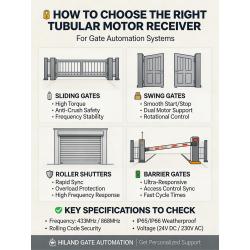
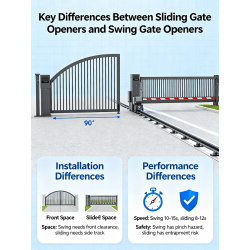
1.3 Sliding and Gate Systems
Some industrial complexes use sliding gates, swing gates, or barriers for access control. In this case, you need specialized gate operators that offer:
- High push/pull force for large gates.
- Robust gearboxes designed for outdoor, exposed installation.
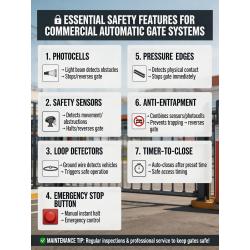
- Integration with access control, loops, or safety photocells.
2. Load Capacity, Duty Cycle, and Operating Frequency
For heavy-duty environments, it is not enough that an opener can simply lift the door once; it must do so repeatedly, day after day, with minimal failure.
2.1 Door Size and Weight
Always verify that the opener’s rated load capacity matches or exceeds your door’s weight and dimensions. Consider:
- Maximum door area (width × height) the opener can drive.
- Door weight including insulation, glazing, and reinforcing ribs.
- Any wind load requirements for external doors.
2.2 Duty Cycle and Daily Operations
Industrial sites may cycle doors dozens or hundreds of times per day. Look for openers specified for high duty cycles, not residential-grade hardware. Important aspects include:
- Continuous or near-continuous operation capability.
- Motor and control design optimized for heat dissipation.
- Heavy-duty gearboxes, bearings, and shafts for longevity.
HILAND’s industrial door openers are engineered specifically for high-frequency, heavy-load applications, which is essential for logistics hubs and manufacturing plants.
3. Motor Technology and Performance
The motor is the heart of any industrial door opener. Its design directly impacts performance, energy efficiency, and maintenance intervals.
3.1 Motor Type and Power
For heavy-duty applications, pay attention to:
- AC vs. DC motors: AC motors are commonly used in industrial settings and can be paired with intelligent controllers.
- Rated power: Ensure the motor has adequate power for your door height, weight, and required speed.
- Overload protection: Thermal or electronic protections extend motor life.
3.2 Speed, Soft Start, and Soft Stop
Speed and movement control directly influence safety, user comfort, and mechanical wear. Modern openers, such as those found in HILAND’s product lines, often incorporate:
- Soft start and soft stop to reduce impact on the door and structure.
- Adjustable opening and closing speed for different application needs.
- Stable, low-noise operation, which is important for commercial and residential-adjacent buildings.
4. Control System and Intelligent Features
Beyond the motor itself, the control system determines how easily and safely your door can be managed. HILAND pays particular attention to intelligent control, giving users flexible operation and diagnostics.
4.1 Control Panel and Programming
Look for an opener with an easy-to-use, robust control unit that offers:
- Clear interface for setup and adjustment.
- Precise limit setting and auto-learning capabilities.
- Diagnostic indicators for troubleshooting.
4.2 Integration with Access and Safety Systems
Modern industrial door openers should integrate seamlessly with other systems. Key features include:
- Support for remote controls, keypads, card readers, or RFID.
- Inputs for photocells, safety edges, loop detectors, and alarms.
- Options for automatic closing with adjustable delay.
4.3 Intelligent Monitoring and Protection
To improve reliability and safety, check whether the opener offers:
- Obstacle detection and auto-reverse functions.
- Overcurrent, overvoltage, and overheating protection.
- Self-diagnostic fault codes to reduce maintenance time.
5. Safety and Compliance
Heavy-duty industrial doors are large moving structures; safety must always be a top priority. High-quality manufacturers like HILAND design their products to comply with international standards and practical on-site safety needs.
5.1 Mechanical and Electrical Safety
Key aspects include:
- Reliable braking system to hold the door in position.
- Emergency manual release or chain hoist for power failures.
- Limit switch systems that prevent over-travel.
5.2 Compliance with Standards
Check whether the opener and its accessories comply with relevant regional and international standards for industrial door safety. Compliance is not only about legal obligations but also about ensuring reliable, tested protection for people and property.
6. Reliability, Durability, and Environmental Resistance
Heavy-duty applications often mean harsh environments: dust, temperature extremes, humidity, or outdoor exposure. The opener should be engineered accordingly.
6.1 Structural Design and Materials
When reviewing product specifications, focus on:
- High-strength housings and industrial-grade components.
- Corrosion-resistant finishes for coastal or humid regions.
- Sealed enclosures for dust and moisture protection.
6.2 Tested Lifespan and Reliability
Reputable manufacturers perform life-cycle tests on their openers. HILAND, for example, positions itself as a comprehensive manufacturer focused on stable, long-lasting solutions tailored to global markets. When selecting a product, look for :
- Declared service life or tested operation cycles.
- Evidence of international usage in demanding environments.
- Positive field feedback or case studies in industrial installations.
7. Installation, Maintenance, and Service Support
Even the best opener can fail prematurely if installed incorrectly or not maintained properly. Ease of installation and service support significantly influence long-term cost and downtime.
7.1 User-Friendly Installation
Consider whether the chosen opener offers:
- Clear, detailed installation guides.
- Flexible mounting options for different door structures.
- Pre-configured wiring or connectors to reduce errors.
7.2 Maintenance Requirements
Heavy-duty operators should be designed for minimal but predictable maintenance. Evaluate:
- Ease of access to key components for inspection.
- Availability of spare parts and accessories.
- Support from the manufacturer or local partners for technical issues.
As a manufacturer with global reach, HILAND emphasizes stable supply, compatibility of accessories, and professional guidance for installers and distributors.
8. Energy Efficiency and Operational Cost
In high-frequency industrial environments, the energy used by door openers is not negligible. Over the life of the system, power consumption and maintenance can represent a significant portion of total cost.
When comparing models, note:
- Motor efficiency and heat management design.
- Standby power consumption of the controller.
- Features such as auto-close to reduce energy loss from open doors.
9. Customization and System Integration
Different industries and regions have different standards and habits. Choosing a manufacturer that understands these differences and offers flexible customization options can significantly improve project outcomes.
HILAND highlights its capability to provide customized solutions based on market requirements. When planning a heavy-duty opener project, discuss:
- Needed voltage and frequency options for your country.
- Customized control logic or interface protocols.
- Compatibility with existing door hardware and accessories.
10. Working with a Specialized Manufacturer
Finally, the manufacturer behind the opener is as important as the product specifications. HILAND focuses on door opener solutions for rolling doors, industrial doors, and gate systems, combining R&D, production, and global sales.
When selecting a supplier for heavy-duty applications, consider:
- Whether they are a dedicated door opener specialist rather than a generalist.
- The breadth of their product portfolio, which reflects accumulated engineering experience.
- Their ability to provide technical documentation, training, and after-sales service internationally.
Conclusion
Selecting an industrial door opener for heavy-duty applications requires a comprehensive evaluation of door type, load capacity, duty cycle, motor and control performance, safety systems, durability, and service support. By focusing on these factors and partnering with a specialized manufacturer like HILAND, facility owners and integrators can ensure that their door systems operate safely, efficiently, and reliably over the long term.
Whether you are upgrading an existing installation or designing a new industrial facility, starting with the right opener choice will reduce downtime, lower maintenance costs, and provide a better user experience for operators and logistics teams.





Leave A Comment